
In recent years, a quiet shift has emerged within primate tourism. More people ask to stay longer, observe with patience, and witness without interruption. These intentions speak to something more considered; an interest in the natural rhythm of gorilla life as it unfolds without instruction.
This article considers that shift. It examines why some visitors now seek a slower, more immersive experience with wild gorillas.
You may already be familiar with what trekking has to offer. But when immersion lasts longer, and the line between watching and being watched begins to blur, the entire purpose of the visit changes.
What exactly does that mean? We’ll look into it carefully.
Understanding Gorilla Habituation
In primatology, the term “habituation” refers to the gradual process through which wild animals grow accustomed to human presence. It is not domestication, but rather an ecological conditioning process that allows scientific observation without altering the animal’s natural behaviour.
Among gorillas, habituation serves as the gateway to close-range monitoring in the wild.
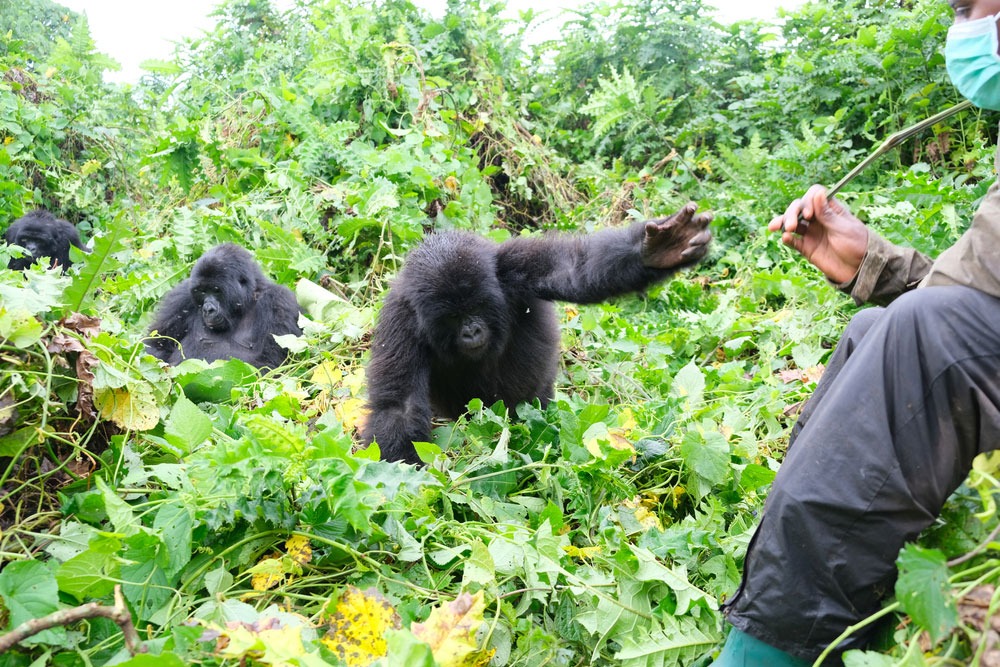
Researchers and conservation teams carry out habituation over several months. Sometimes it stretches beyond two years.
The goal is to ensure that a specific gorilla group remains calm and undisturbed even when humans are nearby.
This requires repeated exposure, always at a controlled distance, and always on foot. The process demands consistency. Gorillas learn to ignore the presence of rangers, rather than welcoming it.
A fixed team, typically composed of trackers and conservation personnel, approaches the same group daily.
Each visit follows strict behavioural protocols. Eye contact is avoided. Movements are minimal. Gorillas decide whether to remain visible or disappear. The process respects this choice.
Over time, dominant silverbacks begin to recognise individual humans by sight or scent. This moment signals the turning point.
Tourists are only introduced at the final stage. By this time, the gorillas have become accustomed to small groups of observers, showing little visible concern.
Uganda’s wildlife authority controls this process and issues a limited number of permits. The groups chosen for tourism have already passed rigorous habituation thresholds.
If you ever wondered what it takes to sit quietly within metres of a wild gorilla, this is the preparation behind that possibility.
Gorilla Trekking – What Most Tourists Do
Gorilla trekking refers to the regulated activity of hiking through forested zones to locate and observe fully habituated gorilla groups. Visitors move in guided teams, often starting early in the morning.
The trek may last anywhere between 30 minutes and 5 hours, depending on gorilla location, trail conditions, and fitness level.
Each trekking team includes a certified ranger, an armed escort, and porters where needed. Groups are capped at eight individuals per gorilla family.
Upon locating the gorillas, visitors are allowed a maximum of one hour in their presence. Photography is permitted, but rules govern proximity, flash usage, and noise levels. Physical distance is maintained at roughly 7 metres, although gorillas sometimes move closer of their own accord.
Permit systems, particularly in Uganda and Rwanda, ensure that trekking demand does not exceed ecological capacity.
This form of gorilla observation remains the most accessible route for those seeking to experience mountain gorillas in their natural habitat.
If you’re planning your first primate-focused trip, this is likely the option your guide will recommend first. It fits within most itineraries and complies fully with conservation guidelines.
What Makes Habituation Deeper
Some experiences do not reveal their significance immediately. They unfold slowly, drawing attention inward.
Gorilla habituation belongs to that category. It invites a form of presence that does not perform. You follow, wait, listen. The group may ignore you. They may not. And yet, something builds in that waiting. Something accumulates.
So, the question remains, what makes the habituation process distinct? Read on below and find out.
1. Extended Duration in the Presence of Gorillas
Habituation permits / licenses last up to four hours. This timeframe creates space for non-scripted observation.
Visitors observe the gradual shift in gorilla behavior over time, including feeding, pausing, vocalizing, and repositioning. The sequence is unpredictable, and that makes the observation richer.
You might find yourself sitting in near silence for long stretches. Not everyone expects that. However, it is often during those quiet, uneventful periods that a more profound understanding begins to take shape.
2. Unfiltered Observation of Behaviour
Partially habituated gorillas behave differently. They remain alert, responsive, and often display more caution than fully habituated groups.
This produces a less curated experience. Visitors may observe the tension within the group, see mock charges, or watch maternal gorillas discipline juveniles.
Every reaction offers insight into natural social behaviour. This is the kind of data researchers rely on, and the type of access that visitors seldom forget.
3. Fewer Humans in the Group
Gorilla habituation allows only four visitors per session. This limit minimises human noise and movement. The result is a cleaner line of observation. Photographers appreciate this.
Similarly, the trackers, whose work depends on maintaining a neutral presence, also do so.
The ranger has more time to explain individual gorillas by name, age, and social role. If you prefer quiet over a crowd, this structure holds clear value.
4. Proximity to Untouched Environments
Habituation occurs in areas that receive lower tourist volumes. Paths may be overgrown. Trails are less formalised. This contributes to a rawer environment.
The experience feels less staged, but it also demands more effort.
Steep gradients, dense undergrowth, and unpredictable weather can all affect the trek. It’s essential to prepare for a physically involved activity. If that sounds like a challenge, it is. But one worth accepting.
5. Heightened Emotional Impact
Prolonged stillness, followed by subtle gorilla movement, creates a rhythm that differs from other wildlife observations. Emotions don’t arrive all at once. They build.
There is no shortcut to this kind of connection. Many visitors describe the final hour as the most affecting, when the gorillas begin to ignore their presence altogether.
That change in gaze, when these magnificent beasts do not consider you a stranger anymore, stays with you.
6. Direct Participation in Conservation
The presence of tourists during habituation has a direct impact on primate science and park management. Rangers use these sessions to reinforce gorilla recognition, document behaviour, and identify signs of injury or stress.
Your permit fee supports those efforts.
Visitors are given a detailed briefing before entering the forest. What they learn is applied immediately. For some, this structured involvement strengthens their sense of purpose while in the field.
Where to Experience Gorilla Habituation
Gorilla habituation experiences are currently offered in only one country: Uganda.
The Uganda Wildlife Authority (UWA) manages all permits and operations under a tightly monitored framework.
These sessions take place exclusively within Bwindi Impenetrable National Park, a UNESCO World Heritage Site situated in the country’s southwest. No other national park or private concession permits visitor access to gorilla groups undergoing habituation.
Within Bwindi, the activity is restricted to specific zones in the Rushaga and Nkuringo sectors. The two gorilla groups currently open for this activity are known as Bikingi and Bushaho.
These groups are at advanced habituation stages but still display variable behaviour. UWA assigns trackers and guides who have worked with these families for extended periods, often on a daily basis.

The forest here is steep, densely vegetated, and prone to mist, especially during early morning hours. You’ll need to prepare physically and dress accordingly.
In Rwanda, habituation experiences are not publicly available. The gorilla groups in Volcanoes National Park are already fully habituated, and access to tourism is limited to standard trekking.
Similarly, in the Democratic Republic of Congo, gorilla habituation is not offered as a regulated tourism product, although the country remains essential to regional primate conservation initiatives.
Permits for Uganda’s habituation experience cost USD 1,500 per person. This includes guide services, park entry, and a maximum of four hours near the gorillas.
Sessions begin early and require in-person registration at UWA’s sector offices by 7:30 AM. If you’re planning your trip, it’s advisable to secure your permit several months in advance, especially during the dry season months from June to August and December to February. Only four permits are issued per group, per day.
Key Differences – Trekking vs Habituation
The terms “trekking” and “habituation” often appear side by side in tourism brochures, but they describe activities with distinct expectations, structures, and outcomes.
The differences matter—especially when deciding where to spend your time, energy, and conservation dollars.
| Aspect | Gorilla Trekking | Gorilla Habituation |
| Visitor Time with Gorillas | 1 hour (timed on arrival) | Up to 4 hours |
| Tourist Group Size | Maximum eight people | Maximum four people |
| Gorilla Behaviour | Fully habituated, calm, and predictable | Semi-habituated, more alert, and reactive |
| Permit Cost (Uganda) | USD 800 per person | USD 1,500 per person |
| Group Availability | Multiple groups per sector | Only 1 or 2 groups per sector |
| Locations Available | Uganda, Rwanda, DRC | Uganda only (Rushaga and Nkuringo sectors) |
| Level of Physical Effort | Moderate to high | High (longer tracking in less-developed forest paths) |
| Primary Purpose | Wildlife tourism and education | Scientific integration and conservation support |
| Booking Demand | High, especially in peak season | Very limited due to permit cap |
| Photographic Opportunities | Structured and timed | Varied, more prolonged exposure, but more unpredictable movement |
Is Gorilla Habituation Right for You?
Gorilla habituation suits individuals who value sustained observation and interaction with these remarkable animals. It attracts people ready to spend extended time in proximity to wild gorillas under careful supervision.
If you find meaning in observing behavioral nuances, such as watching how a juvenile mimics the dominant male’s gestures, this experience aligns with that interest.
Nothing moves quickly. And that creates a different kind of engagement.
It also attracts those who care about fieldwork and scientific context. Some visitors come with notebooks. Others come with questions.
Trackers often explain gorilla posture, vocalisation, and lineage while moving between forest clearings. You don’t need a background in ecology to appreciate this.
But if you’ve ever wondered how wildlife data is collected, this setting will feel remarkably honest.
You should also be prepared for limited comfort. The paths are unmarked. The hours are longer. The forest does not accommodate your pace.
If you’re looking for a steady, focused immersion and you’re ready to pay for that kind of access, habituation is a rare and appropriate choice.
And if you’re unsure? That’s fair. One way to find out is to ask yourself whether you’re curious enough to wait without expecting anything in return.
Conclusion
Conservation work operates on different timescales than tourism. Its pace is shaped by seasons, generational memory, and behavioural change that cannot be rushed.
The opportunity to step briefly into that pace comes with responsibility. Decisions made in offices, forests, and field stations shape what visitors are allowed to witness. Nothing about that arrangement is casual.
If your work or interests lead you into that space, even temporarily, proceed with caution. Time spent inside these processes is limited and cannot be replaced.